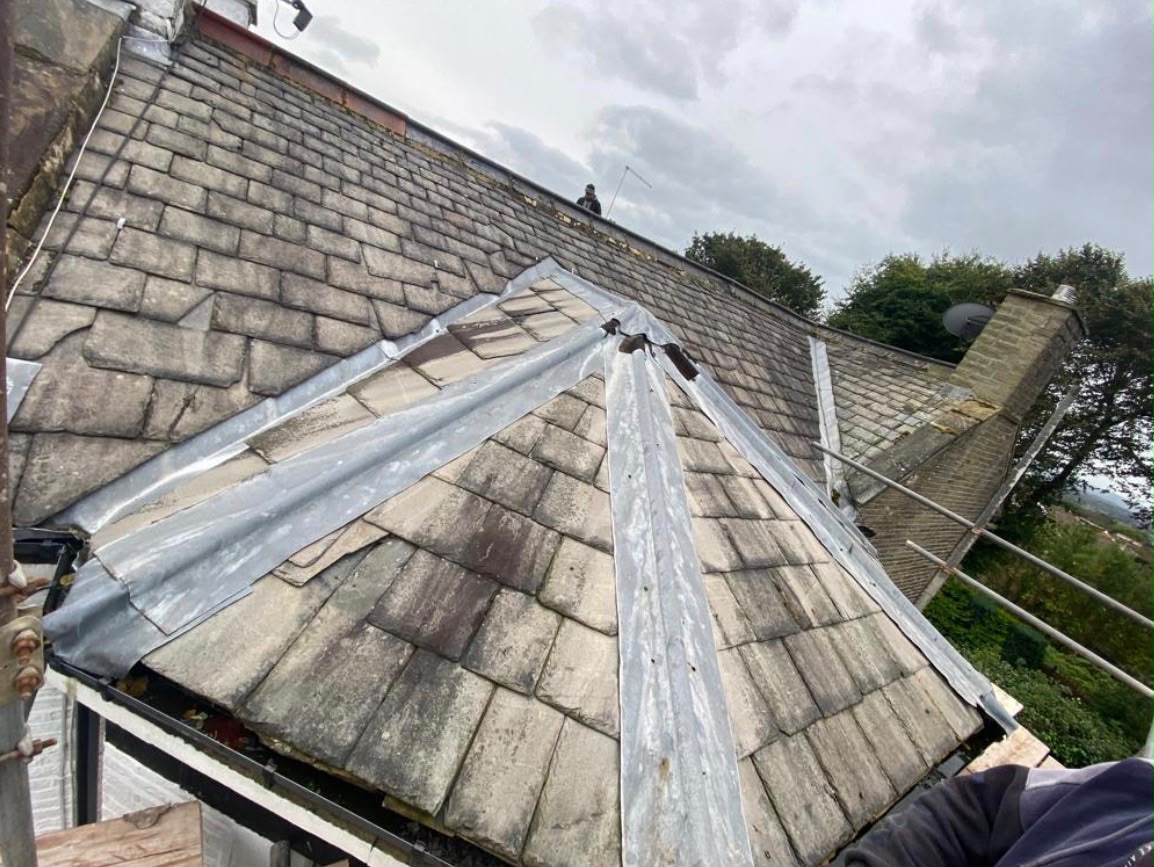
How water actually gets in
The vast majority of roof leaks are not caused by holes in the middle of a tile field or the centre of a flat roof, they're caused by failures at the details: slipped or cracked tiles at valleys, verges and eaves, failed lead flashings around chimneys, abutments and skylights, split or lifted flat-roof upstands, blocked or overflowing gutters backing up under the eaves course, or failed mortar at the ridge and hip lines. Occasionally a lifted or displaced membrane above the tile line lets driven rain past. Diagnosing which of these applies takes physical inspection, not a look from the pavement.
Why water shows up in the wrong place
Once water is inside the roof, it travels, along the underside of a tile, down a rafter, along a ceiling joist, until it finds a low point or an obstacle and drops. The stain on the ceiling is where it finally landed, which can easily be several metres from where it entered the roof. This is why 'the leak is over there' guesses so often result in wasted repairs. We follow the water back rather than guess at where it started.
Emergency response & make-safe
For active leaks we can attend on a 24/7 basis to make the roof watertight and prevent further interior damage. A make-safe is not the final repair, it's a temporary weatherproofing to stop the water while a proper diagnosis and permanent repair are scheduled. Make-safes are always followed by a written report and a fixed-price quote for the permanent fix.
The false economy of patch repairs
A mastic patch or a strip of flashband costs almost nothing in materials but consumes an hour or two of labour and access. If it fails, and applied to the wrong area, it will, you pay for that access and labour again to do it properly. A single correct diagnosis and repair, done first time, is almost always cheaper across a 12-month view than two or three cheap patches.
Repair vs replace decision
Some leaks indicate a genuinely repairable defect on an otherwise sound roof, a slipped tile, a cracked flashing, a localised split. Others are the first visible symptom of a roof reaching end of life, where multiple failures are happening at once or the underlying membrane and battens have degraded. We tell you honestly which situation you're in after inspection. If the roof has years of life left in it we quote to repair; if it doesn't, we say so and quote both options.